The Meaning of an Ordinance:
An Ordinance is an outward and visible symbolic rite commanded in the Bible to be practiced by the church which sets forth a central truth of the Christian faith. It is a memorial or reminder of some precious historical event of great significance. Willmington p. 708
The Distinction between Sacrament and Ordinance.
“A sacrament is something presented to the senses, which has the power, by divine institution, not only signifying, but also efficiently conveying grace.” (as defined by the Roman Catholic Council of Trent in 1551)
An Ordinance therefore differs from a sacrament in that it is performed not to obtain grace, but because the one observing it has already obtained grace.
The Number of the Ordinances.(from Willmington p.708)
The Roman Catholic Church teaches there are seven sacraments. These are: ordination, confirmation, matrimony, extreme unction, penance, baptism, the eucharist (communion).Of these seven the New testament lists but two, and (as we have already seen) regards them as memorial ordinances and not sacraments. They are the Lord’s Supper and Baptism.

A. The Lord’s Supper.
1. The Scriptures describing the Lord’s Supper.
Matthew 26 :26-30; Mark 14:22-26, 1 Cor 11:23-24
Luk 22:17 And he received a cup, and when he had given thanks, he said, Take this, and divide it among yourselves:
Luk 22:18 for I say unto you, I will not drink from henceforth of the fruit of the vine, until the kingdom of God shall come.
Luk 22:19 And he took bread, and when he had given thanks, he brake it, and gave to them, saying, This is my body which is given for you: this do in remembrance of me.
Luk 22:20 And the cup in like manner after supper, saying, This cup is the new covenant in my blood, even that which is poured out for you.
2. The Names for the Lord’s Supper.
a. The Eucharist (Greek for “giving of thanks”.) Taken from 1 Cor 11:24 and when he had given thanks, he brake it, and said, This is my body, which is for you: this do in remembrance of me.
b. The Eulogia (Greek word for “blessing”). Taken from 1 Cor 10:16 “the cup of blessing”
c. The Prosphora (Greek word for “offering”). This came from gifts for the poor given at the supper.
d. Communion. This name is derived from 1 Cor 10 : 16 “ the communion of the blood of Christ.”
RWP A communion of the blood of Christ (Koinéōnia tou haimatos tou Christou). Literally, a participation in (objective genitive) the blood of Christ. The word Koinéōnia is an old one from Koinéōnos, partner, and so here and Phi_2:1; Phi_3:10. It can mean also fellowship (Gal_2:9) or contribution (2Co_8:4; Phi_1:5). It is, of course, a spiritual participation in the blood of Christ which is symbolized by the cup. Same meaning for Koinéōnia in reference to “the body of Christ.”
The bread which we break (ton arton hon klōmen). The loaf. Inverse attraction of the antecedent (arton) to the case (accusative) of the relative (hon) according to classic idiom (Robertson, Grammar, p. 488). Artos probably from arō, to join or fit (flour mixed with water and baked). The mention of the cup here before the bread does not mean that this order was observed for see the regular order of bread and then cup in 1Co_11:24-27.
Is it not the communion of the blood of Christ? - Is it not the emblem by which the blood of Christ is exhibited, and the means by which our union through that blood is exhibited? Is it not the means by which we express our attachment to him as Christians; showing our union to him and to each other; and showing that we partake in common of the benefits of his blood? The main idea is, that by partaking of this cup they showed that they were united to him and to each other; and that they should regard themselves as set apart to him. We have communion with one κοινωνία koinōnia,) that which is in “common,” that which pertains to all, that which evinces fellowship) when we partake together; when all have an equal right, and all share alike; when the same benefits or the same obligations are extended to all. And the sense here is, that Christians “partake alike” in the benefits of the blood of Christ; they share the same blessings; and they express this together, and in common, when they partake of the communion.

e. The Breaking of the Bread.
Act 2:42 And they continued stedfastly in the apostles' teaching and fellowship, in the breaking of bread and the prayers.
Act 2:46 And day by day, continuing stedfastly with one accord in the temple, and breaking bread at home, they did take their food with gladness and singleness of heart,
A.Clark: And in breaking of bread - Whether this means the holy eucharist, or their common meals, it is difficult to say. The Syriac understands it of the former. Breaking of bread was that act which preceded a feast or meal, and which was performed by the master of the house, when he pronounced the blessing - what we would call grace before meat. See the form on Mat_26:26
RWP : It is generally supposed that the early disciples attached so much significance to the breaking of bread at the ordinary meals, more than our saying grace, that they followed the meal with the Lord’s Supper at first, a combination called agapai or love-feasts. “There can be no doubt that the Eucharist at this period was preceded uniformly by a common repast, as was the case when the ordinance was instituted” (Hackett). This led to some abuses as in 1Co_11:20. Hence it is possible that what is referred to here is the Lord’s Supper following the ordinary meal. “To simply explain tēi klasei tou artou as=‘The Holy Communion’ is to pervert the plain meaning of words, and to mar the picture of family life, which the text places before us as the ideal of the early believers” (Page). But in Act_20:7 they seem to have come together especially for the observance of the Lord’s Supper. Perhaps there is no way to settle the point conclusively here.
2. The different Views of the Lord’s Supper.
a. Transubstantiation
The Roman Catholic Doctrine which teaches that the bread and wine actually become the body and blood of Christ when consecrated, by the priest during mass even though they still look and taste the same. Thus the one partaking, literally eats Christ’s flesh and drinks His blood. Needless to say this is without Scriptural support.

In fact it is totally refuted by the Book of Hebrews. WNT
Heb 7:24 but He, because He continues for ever, has a priesthood which does not pass to any successor.
Heb 7:25 Hence too He is able to save to the uttermost those who come to God through Him, seeing that He ever lives to plead for them.
Heb 7:26 Moreover we needed just such a High Priest as this--holy, guileless, undefiled, far removed from sinful men and exalted above the heavens;
Heb 7:27 who, unlike other High Priests, is not under the necessity of offering up sacrifices day after day, first for His own sins, and afterwards for those of the people; for this latter thing He did once for all when He offered up Himself.
Heb 9:12 and once for all entered the Holy place, taking with Him not the blood of goats and calves, but His own blood, and thus procuring eternal redemption for us.
Heb 9:13 For if the blood of goats and bulls and the ashes of a heifer sprinkling those who have contracted defilement make them holy so as to bring about ceremonial purity,
Heb 9:14 how much more certainly shall the blood of Christ, who strengthened by the eternal Spirit offered Himself to God, free from blemish, purify your consciences from lifeless works for you to serve the ever-living God?
Heb 9:24 For not into a Holy place built by men's hands--a mere copy of the reality--did Christ enter, but He entered Heaven itself, now to appear in the presence of God on our behalf.
Heb 9:25 Nor did He enter for the purpose of many times offering Himself in sacrifice, just as the High Priest enters the Holy place, year after year, taking with him blood not his own.
Heb 9:28 so the Christ also, having been once offered in sacrifice in order that He might bear the sins of many, will appear a second time, separated from sin, to those who are eagerly expecting Him, to make their salvation complete.
Heb 10:11 And while every priest stands ministering, day after day, and constantly offering the same sacrifices--though such can never rid us of our sins--
Heb 10:12 this Priest, on the contrary, after offering for sins a single sacrifice of perpetual efficacy, took His seat at God's right hand,
b. Consubstantiation
Consubstantiation is a theological doctrine that (like Transubstantiation) attempts to describe the nature of the Christian Eucharist in concrete metaphysical terms. It holds that during the sacrament, the fundamental "substance" of the body and blood of Christ are presentalongside the substance of the bread and wine, which remain present. The doctrine of consubstantiation is often held in contrast to the doctrine of transubstantiation. The adjective consubstantial however describes a different theological concept.
The doctrine of consubstantiation is erroneously identified as the eucharistic doctrine of Martin Luther,[1] who defined his doctrine as thesacramental union.[2] While some Lutherans believe in consubstantiation, others reject the concept because it substitutes what they believe to be the biblical doctrine with a philosophical construct and implies, in their view, a natural, local inclusion of the body and blood of Christ in the consecrated bread and wine of the eucharist.[3]<Wikipedia.org/ wiki/ consubstattiation>
c. Memorialisation.
The Doctrine which teaches that the bread and the wine are mere symbols to remind and aid the believer in observing both the first and second comings of our Lord. This practice is both Scriptural and sensible .
1Co 11:23 For it was from the Lord that I received the facts which, in turn, I handed on to you; how that the Lord Jesus, on the night He was to be betrayed, took some bread,
1Co 11:24 and after giving thanks He broke it and said, "This is my body which is about to be broken for you. Do this in memory of me."
1Co 11:25 In the same way, when the meal was over, He also took the cup. "This cup," He said, "is the new Covenant of which my blood is the pledge. Do this, every time that you drink it, in memory of me."
1Co 11:26 For every time that you eat this bread and drink from the cup, you are proclaiming the Lord's death--until He returns.
1Co 11:27 Whoever, therefore, in an unworthy manner, eats the bread or drinks from the cup of the Lord sins against the body and blood of the Lord.
1Co 11:28 But let a man examine himself, and, having done that, then let him eat the bread and drink from the cup.
1Co 11:29 For anyone who eats and drinks, eats and drinks judgement to himself, if he fails to estimate the body aright.
1Co 11:30 That is why many among you are sickly and out of health, and why not a few die.
1Co 11:31 If, however, we estimated ourselves aright, we should not be judged.
.jpg)
4. The Old Testament Type of the Lord’s Supper.
A beautiful Type is seen in the Passover Lamb and the sprinkled blood of which saved the Israelite from the death plague in Egypt prior to the Exodus. Willmington. p.709
Exo 12:12 For I will pass through the land of Egypt this night, and will smite all the first-born in the land of Egypt, both man and beast. And I will execute judgments against all the gods of Egypt. I am Jehovah.
Exo 12:13 And the blood shall be a sign to you upon the houses where you are. And when I see the blood, I will pass over you. And the plague shall not be upon you for a destruction when I smite in the land of Egypt.
Exo 12:21 Then Moses called for all the elders of Israel and said to them, Draw out and take a lamb for yourselves according to your families, and kill the passover.
Exo 12:22 And you shall take a bunch of hyssop and dip in the blood in the bowl, and strike the lintel and the doorposts with the blood in the bowl. And none of you shall go out of the door of his house until the morning.
Exo 12:26 And it will be, when your sons shall say to you, What is this service to you?
Exo 12:27 Then you shall say, It is the sacrifice of Jehovah's passover, who passed over the houses of the sons of Israel in Egypt, when He struck the Egyptians and delivered our houses. And the people bowed and worshiped.
Note that in the New Testament Paul connects the Passover Lamb with the Lord’s Table.
1Co 5:7 Therefore purge out the old leaven so that you may be a new lump, as you are unleavened. For also Christ our Passover is sacrificed for us.
1Co 5:8 Therefore let us keep the feast; not with old leaven, nor with the leaven of malice and wickedness, but with the unleavened bread of sincerity and truth.
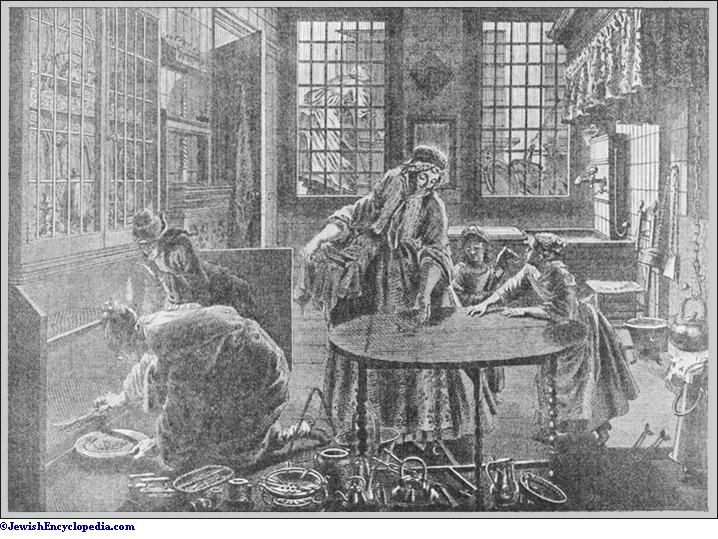 |
| Removing all leaven or yeast |

5. The Purpose of the Lord’s Supper
The Lord’s Supper has Three Aspects :
a. We are to look backwards.
1Co 11:26 For every time that you eat this bread and drink from the cup, you are proclaiming the Lord's death--until He returns.
b. We are to look inwards.
1Co 11:28 But let a man examine himself, and, having done that, then let him eat the bread and drink from the cup.

c. We are to look forward.
“Until He Returns.” 1 Cor. 11:26

6. The Partakers of the Lord’s Supper.
Who are invited to the Table. It is only for believers. In Africa there was a special believers meeting for the Lord’s Supper. It does include all believers. It should not be used as a disciplinary means where certain ones are excluded.
Some denominations refuse to allow believers from other denominations to partake with them. They are exclusive.
 7. The Prerequisites of the Lord’s Supper.

A prerequisite is a required prior condition. If something is required in advance of something else. vocabulary.com
Individuals who are forbidden are the unsaved and the unclean. To the Unsaved the Apostle John wrote for us John 3:16 For God so loved the world that He gave His only-begotten Son, that whoever believes in Him should not perish but have everlasting life.
For the Unclean He wrote :1Jn 1:9 If we confess our sins, He is faithful and just to forgive us our sins, and to cleanse us from all unrighteousness.

8. The Penalty for eating unworthily.
1Co 11:29 For he who eats and drinks unworthily eats and drinks condemnation to himself, not discerning the Lord's body.
1Co 11:30 For this cause many among you are weak and sickly, and many sleep.
Unworthily: irreverently anaxiōs
Thayer Definition:
1) in an unworthy manner
Eateth and drinketh damnation - Κριμα, Judgment, punishment; and yet this is not unto damnation, for the judgment or punishment inflicted upon the disorderly and the profane was intended for their emendation; for in 1Co_11:32, it is said, then we are judged, κρινομενοι, we are chastened, παιδευομεθα, corrected as a father does his children, that we should not be condemned with the world.
not discerning — not duty judging: not distinguishing in judgment (so the Greek: the sin and its punishment thus being marked as corresponding) from common food, the sacramental pledges of the Lord’s body. Most of the oldest manuscripts omit “Lord’s” (see 1Co_11:27). Omitting also “unworthily,” with most of the oldest manuscripts, we must translate, “He that eateth and drinketh, eateth and drinketh judgment to himself, IF he discern not the body” (Heb_10:29). The Church is “the body of Christ” (1Co_12:27). The Lord’s body is His literal body appreciated and discerned by the soul in the faithful receiving, and not present in the elements themselves.
The Communion service among the fickle and self-centered Corinthians had so involved themselves in the supper that they and totally ignored the other saints and the Saviour Himself. As a result some would stuff themselves with food and drink while others would go away hungry from the Agape Feasts. [fellowship meals with breaking of Bread] The Communion service was then limited to the Bread and the Wine.
9. The Frequency of the Lord’s Supper.
How often should it be observed? Some churches do it every three months and usually precede it by a preparation service during the week prior to the Celebration. Other do it every months while still other once a week. After the death and Resurrection of our Lord the disciples seem to have observed it every day at the end of a meal together.Acts 2:46 and Acts 20:7
Actually, the Scriptures do not specify the frequency.